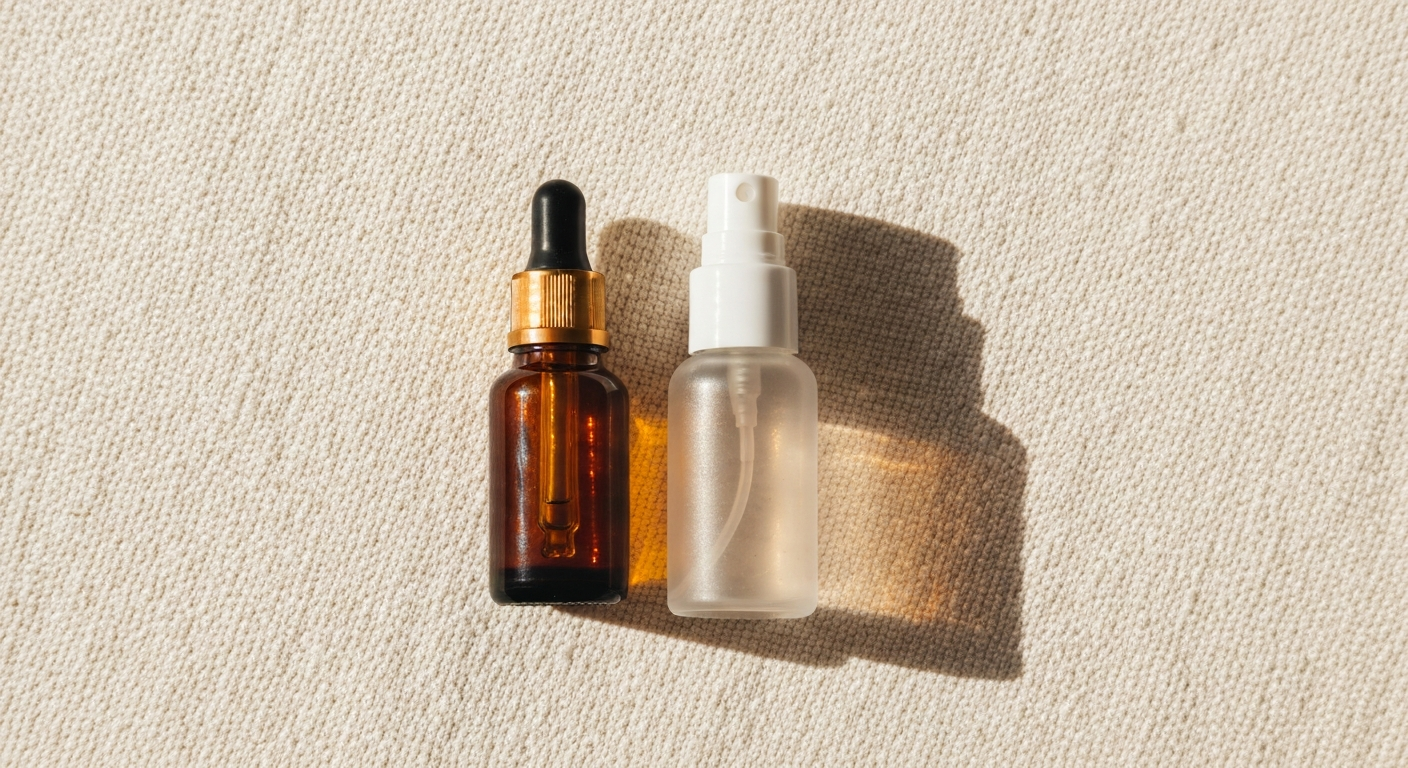
Same molecules. Different carrier. Genuinely different on skin. A $30 oil and a $60 spray can share an ingredient list and still behave nothing alike at hour three. The reason is the carrier, not the marketing.
Quick disclosure: we may earn a commission if you buy through the links below. It does not change which products we recommend. For the bigger question of whether any of this works at all, see do pheromone perfumes work .
The headline difference
Oils use a lipid carrier. Usually fractionated coconut, jojoba, or a light silicone. That carrier mixes with your skin's hydrophobic layer, the sebum and lipids on the stratum corneum. From there it releases the active molecules slowly, over hours.
Sprays use an alcohol carrier. Typically SD alcohol 40 with a little water. The alcohol flashes off in under a minute. That leaves the fragrance and pheromone compounds sitting on top of the skin, not mixed into it. That one mechanical difference drives almost every tradeoff that follows.
Pheromone retention: oils win
When the carrier oil mixes with your skin's natural lipids, the pheromone molecules act more like compounds your body would emit on its own. They stay close to the skin. They release on a curve that resembles natural emission, not a perfume burst.
Sprays dump most of the volatile load into the air column at application. A meaningful fraction is gone in the first ten minutes. The alcohol evaporates and carries the lighter molecules with it. What stays on skin is mostly the fragrance oils, plus whatever heavier compounds bonded with your skin lipids before the alcohol left.
Some molecules have documented social signal. Androstenone and copulins especially. The slower oil release is closer to how the body would actually emit them. Formal studies on the size of that effect are thin, since human chemosignal work is expensive and rarely funded. But the mechanism holds up, and that closer-to-natural release is a real reason oils tend to land.
Sillage and projection: sprays win
Sillage is the trail you leave when you walk through a room. Projection is how far the scent reaches from your skin. Sprays win both, by a wide margin.
A two-pump spray hits more olfactory receptors faster. It disperses into a wider plume, atomizes finer, and uses alcohol to throw aromatic molecules into the air. Oils stay close to the wearer. Someone has to be inside arm's length to read an oil clearly. In a crowded bar or a meeting room, that intimacy is either the point or a limitation. Depends on your goal.
Application precision: oils win
Oils usually come as a roll-on or a dab vial. You control the dose in fractions of a drop. A spray pump gives you whatever the atomizer delivers, usually around 0.1 ml. You cannot easily go smaller.
Precision matters most with androstenone . Saxton's 2008 work, and a stack of perception studies since, show the response curve is non-linear. A small amount reads as dominant, confident, masculine. Too much reads as aggressive, sweaty, off-putting. A roll-on lets you stop at one stripe on the inner wrist. A spray makes that almost impossible to dial in. For a deeper walkthrough, see how to apply pheromone oil .
Longevity on skin: oils win
Rough working numbers, from user reports and our own bottle-by-bottle testing:
- Oils: 4 to 8 hours of measurable presence on skin. Sometimes longer on dry winter skin.
- Sprays: 2 to 5 hours. The heaviest dropoff hits in the first 90 minutes, as the alcohol finishes evaporating.
Want one application to cover a full evening with no touch-up? Oils have the structural advantage. If you do not mind re-spraying after dinner, the gap matters less.
Travel: oils edge
Small roll-on oils, usually 10 ml or under, slide into a carry-on without a thought. TSA's 3-1-1 liquids rule still applies. But a 10 ml vial sits well under the 100 ml ceiling, so you do not have to do anything special.
Sprays larger than 100 ml have to go in checked luggage. Smaller pump sprays count toward your single quart-bag allowance. Not a dealbreaker. But if you live out of a carry-on, an oil is one less thing to think about at security.
Scent intensity at first contact: sprays win
Sometimes the goal is a first-impression moment. A date pickup, a job interview, walking into a room where someone needs to register you in the first 60 seconds. A spray gives you a bigger opening. The alcohol pushes the top notes outward fast, and the projection is real.
Oils start quieter. They get noticed once someone is already close. A hug hello, a lean-in to read a menu, sitting next to you on a couch. That is a different kind of intensity. Not worse, just slower.
When to choose oil
- You want the signal to sit close to your body's natural emission, not broadcast outward.
- You plan to layer with your usual cologne. Unscented oils combine cleanly with the fragrance you already wear. That is the whole technique covered in layering pheromone cologne with fragrance , with the gendered version in pheromone perfume layering tips .
- You need precision dosing, especially for androstenone-heavy blends.
- You want longer wear without reapplying mid-day.
- You travel light.
For curated options, see our best pheromone oils roundup.
When to choose spray
- You want one finished product that does both jobs. Smells like a designer fragrance and carries the pheromone load. No layering, no technique.
- You want broad coverage. Two pumps to chest and neck, and you are out the door.
- You prioritize first-impression projection over all-day persistence.
- You do not want to think about wrist placement, pulse points, or how it interacts with your existing cologne.
Format guides by audience: best pheromone cologne for men's sprays generally. Then best pheromone perfumes for men and best pheromone perfumes for women for the top finished products.
Specific picks
Oils
- RawChemistry . The default starter oil. Unscented, dosed conservatively on androstenone, easy to layer.
- Athena . The longest-running brand in the category, built on Cutler's own copulins research. A specialist product, not a general cologne.
Sprays
- Pure Instinct . Unisex, citrus-amber, the most beginner-friendly finished spray on the market.
- Pherazone . Heavier pheromone concentration, marketed harder than it needs to be. The bottle delivers anyway.
- Nexus Pheromones . Classic men's spray, built to compete with mainstream colognes on scent first.
FAQ
Can I use both?
Yes, and a lot of people do. The common stack is an unscented oil on pulse points for the long-release base. Then a scented spray on the chest and shoulders for the projection layer. Apply the oil first. Give it two minutes to settle, then spray.
Do sprays contain less pheromone than oils?
Not necessarily. The label concentration can be similar. The difference is what fraction stays on your skin after the carrier does its job. Alcohol carriers are good at moving fragrance into the air. They are worse at depositing pheromone molecules into your skin lipids. Oils are the inverse.
Does the format change how others perceive me?
Indirectly, yes. A spray reads as a finished fragrance. People compliment the scent and may not consciously register anything else. An unscented oil reads as skin, which is a more intimate signal. The formal literature on human pheromones is still thin, and Wyatt 2015 lays out how little has been rigorously tested. That is a gap in the research, not a disproof. The candidate pathways are real, including the terminal nerve some researchers propose, and fifteen years of field reports keep pointing the same way. Format shifts the social register of the product either way.
Which is better value?
Per application, oils. A 10 ml roll-on at $25 gives roughly 200 applications. A 30 ml spray at $50 gives roughly 150 to 200 pumps, but you typically use two to four per application. The math favors the oil if you wear the product daily.
What if I have sensitive skin?
Oils are usually friendlier. Alcohol-based sprays can sting freshly shaved skin and dry out the area over time. A jojoba or fractionated coconut carrier sits closer to neutral. Patch test either format on the inner elbow for 24 hours before you commit.
The short version
Oil for retention, precision, longevity, layering, and travel. Spray for projection, first impressions, and one-product convenience. If you only buy one and you are new to this, start with an unscented oil. It teaches you how the molecules behave on your skin. Once you know that, picking a spray you actually like gets much easier.
No comments yet