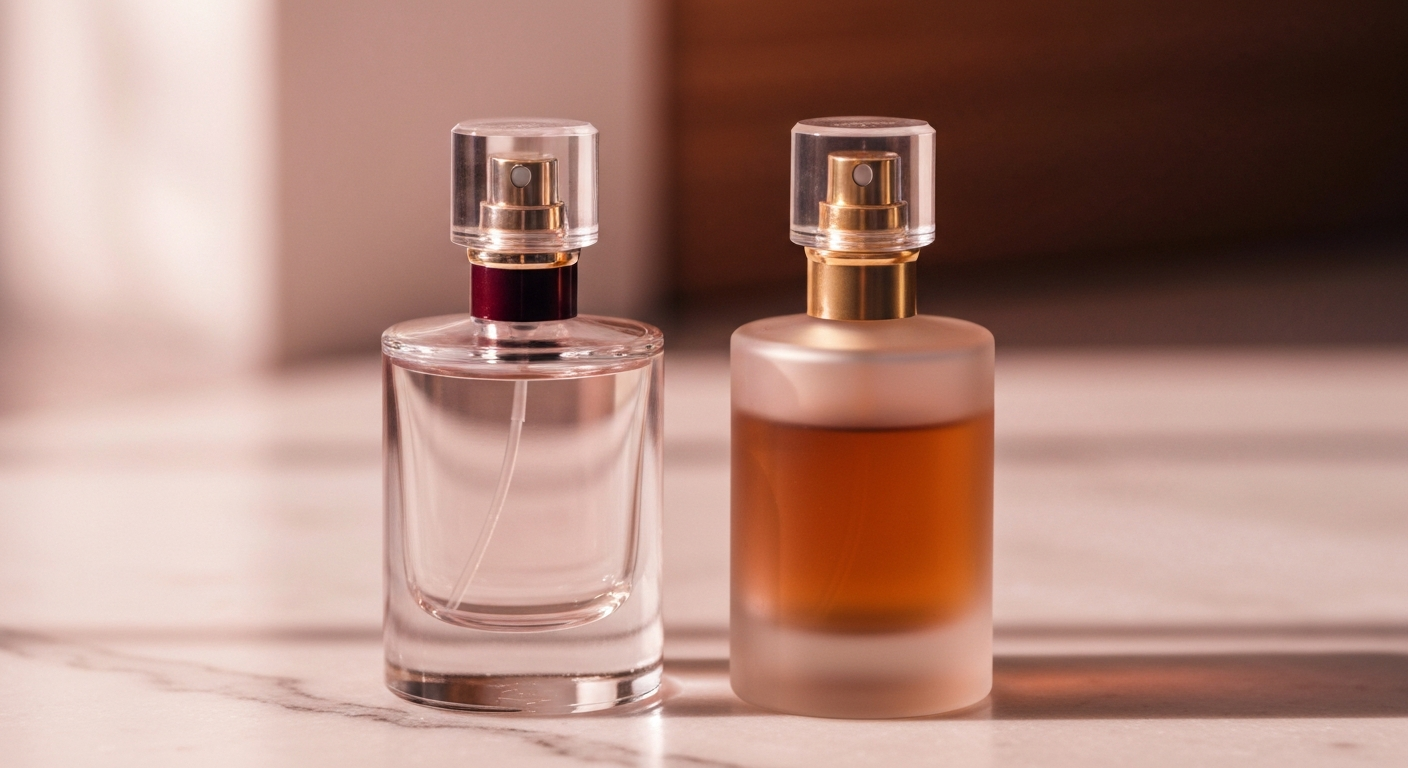
Walk the fragrance aisle at Sephora. Then open a pheromone-perfume listing on Amazon. They look like the same category. They are not. A regular women's perfume is a composition. A perfumer built it to smell a specific way. A pheromone perfume is a fragrance base, usually simpler, with one or two extra molecules dropped in. Those molecules change how people respond to you. Same bottle shape. Very different brief.
Here is the honest breakdown. How the two categories differ. Where the pheromone side earns its keep, and where a lot of the market is still selling you a sticker.
The headline difference, in one sentence
A pheromone perfume is a regular perfume with added copulins or androstadienone . Often a lighter, simpler one. Strip those two molecules out and you are left with a fragrance. Usually less complex than what a mainstream brand sells at the same price.
What is inside a regular women's perfume
A designer or niche women's perfume is built in three layers.
- Top notes — the first ten to twenty minutes. Citrus, aldehydes, pink pepper, green leaves, bergamot. Bright and volatile.
- Heart notes — the middle hour or two. Florals like rose, jasmine, tuberose, iris. Fruit and spices. The personality of the scent.
- Base notes — what sits on your skin four to eight hours in. Amber, musk, vanilla, sandalwood, oakmoss, patchouli. The trail.
Women's perfumes also tend to run more concentrated than men's colognes. An eau de toilette sits around 5 to 15 percent aromatic compounds. An eau de parfum is the standard for most women's launches now. It sits at 15 to 20 percent. Pure parfum, or extrait, pushes 20 to 30 percent.
Higher concentration means more sillage, more lasting power, and more cost. A bottle of Chanel No. 5 EDP at $145 carries meaningfully more aromachemical mass than a $40 EDT. You are paying for the fragrance, not just the name.
The result is a fragrance designed to evolve on skin and to be recognisable. You smell Black Opium across a room. You smell Libre or Good Girl or J'adore and you know. That recognisability is a design choice. It takes a perfumer's time and a brand's budget.
What is added in a pheromone perfume
Two molecules show up in almost every women's pheromone perfume worth considering.
Copulins
A blend of short-chain fatty acids. Acetic, propanoic, butanoic, isovaleric. They were originally identified in vaginal secretions. Small studies suggest they may shift male testosterone or perceived attractiveness ratings. The literature is small because the field is thinly funded, not because the effect was ruled out. Most women's pheromone perfumes lean on copulins as the primary active.
Androstadienone
A steroid derivative present in male sweat. Some brands add it to women's formulas. The idea is that it raises the wearer's own mood or arousal, rather than affecting the people around her. Saxton 2008 found a modest attractiveness-rating bump at speed-dating events. Hare 2017 did not reproduce the social effects. Two small studies, opposite results, is where a young field sits before anyone funds the big one.
You will also see estratetraenol on some labels. And a few proprietary blends with no published evidence at all. Treat those as marketing.
The fragrance these molecules sit inside is usually simple. Clean musks, vanilla, light florals, a transparent amber. Formulators keep the carrier scent light on purpose. They do not want a heavy chypre or a smoky oud fighting with whatever the copulins are doing. That choice has consequences. More on that below.
Cost and concentration
A 30 ml bottle of pheromone perfume runs roughly $25 to $100. Pure Instinct is around $22 for 10 ml of roll-on oil. Athena Pheromones costs near $100 for a small bottle of unscented additive you blend into your own perfume. RawChemistry sits in the $30 to $50 range. Pheromone Treasures lands similarly.
A designer women's perfume in the same bottle size runs $80 to $200. Niche releases push $200 to $400 routinely. Think Le Labo, Maison Margiela, Frederic Malle. Part of that gap is marketing and brand premium. Part of it is real. Higher concentration, more expensive raw materials, a perfumer with a real name on the box.
Compare price per millilitre of fragrance quality and designer perfumes usually win. Compare price per attempt at a pheromone effect, and designer perfumes do not offer one at all. So the comparison breaks.
Scent quality, honestly
This is the part most pheromone-perfume marketing skips. The average pheromone perfume does not smell as good as the average designer perfume at twice the price. The carrier scents lean toward clean, slightly sweet musk profiles. They are built around synthetic musks and a soft amber, sometimes with a vanilla or coconut accent. Pleasant. Often a little generic.
Maybe you love a heavy chypre, a smoky oud, a complex oriental, or anything in the gourmand-niche space. Kilian Love Don't Be Shy. Tom Ford Lost Cherry. Maison Francis Kurkdjian Baccarat Rouge 540. The pheromone-perfume category is not where to look. The juice you would have to add copulins to does not really exist at the price point most pheromone brands target.
What the better pheromone perfumes do well: a soft, skin-close scent. A clean musk drydown. Just enough sweetness to read feminine without announcing itself. Pure Instinct is probably the best-known example of the type. It smells like a slightly sweetened version of your own skin. That is exactly the point. Iso E Super shows up in a lot of these formulas because it does that skin-extension trick cheaply.
Effect comparison
A regular perfume affects how people respond to you. It works through scent, memory, and a social signal. Someone who chose to smell deliberate. That is real and well understood. Wear something distinctive enough times and people start associating the scent with you.
A pheromone perfume does that and adds a chemical nudge. How large that nudge is in humans is still an open question . The Cutler 1998 axillary-extract studies and the Saxton 2008 androstadienone work point to something real. Wyatt 2015 is the careful voice on the other side. He argues most positive studies do not yet meet the bar pheromone research uses for other mammals. Hare 2017 did not reproduce two of the most cited effects. Contested, yes. Closed, no. And much of the skeptical case aims at the wrong organ.
The terminal nerve, sometimes called cranial nerve zero, is a real nerve running from the nose to the forebrain that some researchers propose as a pathway for human chemosignals. The old "humans have no working VNO, so this is impossible" line is aimed at the wrong door. Confidence plays a part too. A scent you trust changes how you carry yourself. Chemistry and confidence stack. It is not one instead of the other.
What also lands reliably: people who wear a scent they like move differently. That is true of any well-chosen perfume. The pheromone version stacks a plausible chemical signal on top of that.
Which to buy when
The framing that actually makes sense: do not pick one. Layer them.
This is the trick RawChemistry and Athena lean on, even if they don't say it out loud. Apply an unscented or very lightly scented pheromone oil to your pulse points first. Wrists, base of throat, behind the ears. Let it dry for two or three minutes. Then spray your real perfume on top. The signature scent everyone notices is the designer perfume. The copulins do their work underneath. They never change what you smell like to a person standing a metre away.
Practical buy paths
- Curious, low budget — Pure Instinct roll-on, $22. Wear it alone or under a light EDT you already own.
- Want to keep your signature perfume — buy an unscented pheromone additive and layer it underneath whatever you normally wear. Athena 10:13 is the canonical option. RawChemistry's unscented works too.
- Want a one-bottle solution — RawChemistry or Pheromone Treasures' scented formula. You give up some scent depth. You get one product to apply.
- Care more about smelling expensive than about pheromones — buy a niche perfume and skip the pheromone category entirely. There is no shame in that path.
Want category-by-category picks across both ends? The best pheromone perfumes for women pillar and the pheromone perfumes buying guide cover the rest.
FAQ
Will a pheromone perfume replace my regular perfume?
Probably not, if you already love your regular perfume. Most pheromone perfumes are scent-light by design. Treat them as a layer underneath, not a swap.
Can I layer a pheromone oil under any designer perfume?
Yes. Apply the oil first. Let it set for a couple of minutes. Then spray your designer scent on top. The copulins and the perfume don't fight each other. The copulin molecules are too subtle to register against the perfume's volume.
Are pheromone perfumes more concentrated than regular perfumes?
Usually less concentrated, in fragrance terms. A pheromone perfume's listed concentration refers mostly to the pheromone additive, not the aromatic compounds. The carrier scent is typically lighter than an eau de parfum.
Why do pheromone perfumes cost less than designer perfumes?
Smaller brands, no celebrity ad campaigns, simpler scent compositions, and no department-store margin. The copulin or androstadienone ingredient cost is also low at the dilutions used.
Do pheromone perfumes actually work?
The mechanism is plausible and the good products deliver. Real studies, Cutler 1998 and Saxton 2008, show small effects. Big replications like Hare 2017 have not landed them yet, which reflects how little the field has been funded, not a verdict against it. Add the terminal-nerve pathway and fifteen years of forum users reporting the same shifts, and the pattern holds up. Buy a real formula, not a body spray with a pheromone sticker.
We may earn a commission if you buy through links in this article. It does not change which products we recommend or what we say about them.
No comments yet