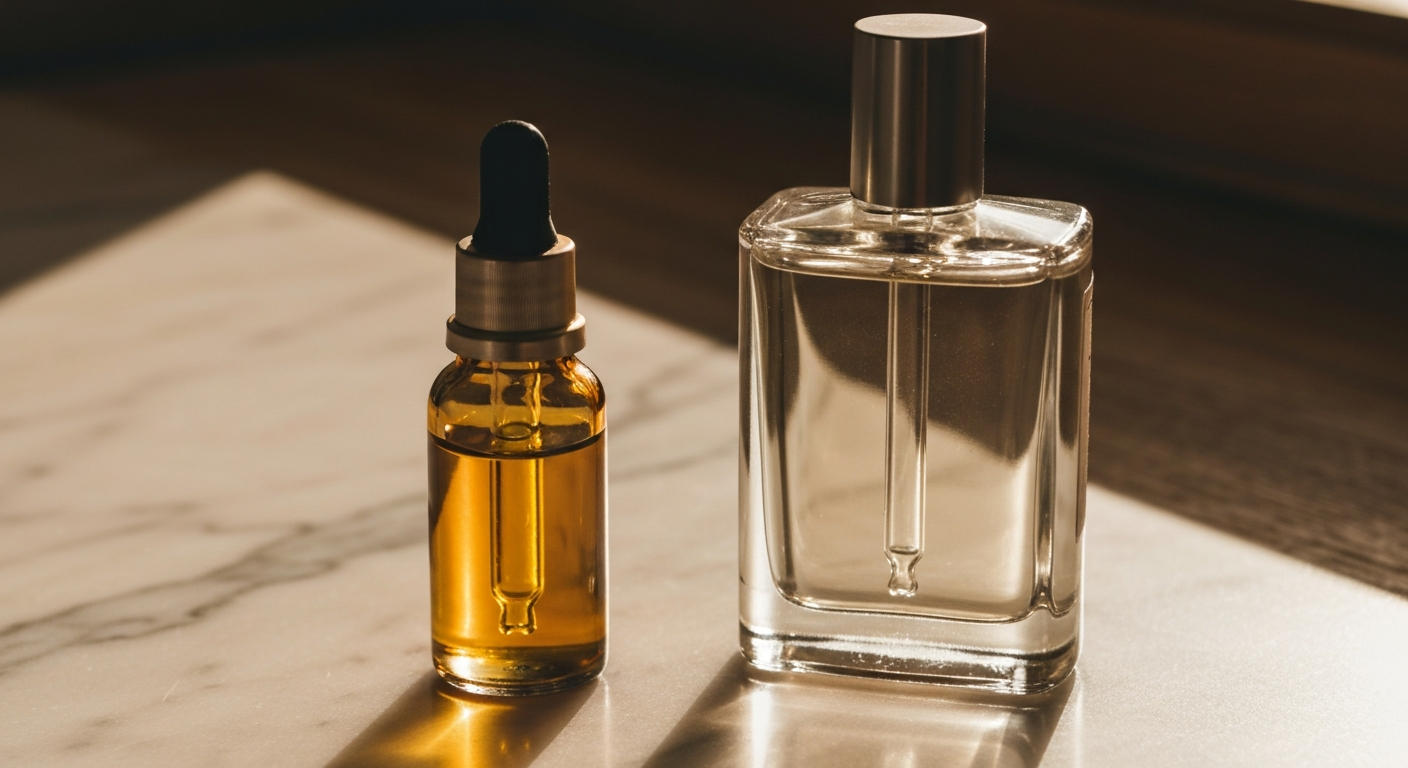
Pheromone oils are quiet by design. A faint skin musk, a touch of carrier-oil sweetness, and that's the whole top note. Layer a perfume on top and the oil should vanish under the perfume's structure. What's left is a warm, slightly animalic base. Sometimes it works beautifully. Sometimes the perfume fights the oil and you smell like an overcrowded changing room. The trick is knowing which fragrances play nice with a musk-based oil and which ones don't.
The pairing logic
Most pheromone oils sit on a carrier of fractionated coconut or jojoba. That carrier gets a small dose of fragrance, usually a clean skin-musk accord, plus the active molecules. Those actives are typically synthetic musks like galaxolide, or a touch of iso e super for that ambient, near-skin lift. The musk base is what you design around. Spray a perfume on top and its base notes share the same airspace as the oil's musks. If the two musk profiles agree, you get depth. If they clash, you get a muddled, slightly sour skin print neither of you wanted.
The general rule is simple. The lighter and cleaner the perfume on top, the more the oil contributes underneath. The heavier and more musk-dominant the perfume, the more the oil becomes background noise. Or worse, an unwanted accent.
What pairs well
Light, clean, transparent fragrances are the natural home for a layered oil. Think citrus colognes, aquatics, fresh florals, green soliflores. Anything built on a top-and-heart structure with a quiet base. These leave room for the oil's skin-musk to whisper through the gaps. That's exactly what you want. The perfume reads as the dominant scent. The oil reads as your skin.
Anything reviewers call "transparent," "airy," "watery," "crisp," or "summery" is a safe start. If the perfume has a quiet drydown, the oil fills the silence.
What pairs poorly
Heavy gourmand orientals are where this gets ugly. Oud, vanilla, amber, tonka, big-budget ambroxan bombs. These already saturate the skin with their own musks, resins, and balsams. Layer a pheromone oil under that and one of two things happens. Either the oil vanishes completely, and you spent money for nothing. Or the oil's musks bump heads with the perfume's musks. That produces a muddled, slightly off top note that lingers in a way nobody asked for.
It's not that you can't wear oil under a heavy perfume. You just need to use much less. A single dab on one pulse point, not the usual two or three. And you have to accept that the perfume is doing all the work. The oil is contributing maybe 10% at most.
Specific pairings for men
These are real, well-known fragrances most readers will recognize. The notes assume you're using a standard unscented or lightly-scented oil underneath, like Pure Instinct or RawChemistry . We may earn a commission if you buy through our links.
Pheromone oil + Bleu de Chanel = clean modern masculine layer
Bleu de Chanel is a near-universal safe blue. Fresh citrus opening, a smooth incense-woody heart, mild ambroxan in the base. It's clean enough that an oil underneath adds warmth without fighting it. The oil's skin-musk pushes the drydown more skin-on-skin and less polished magazine spread. Strong pairing for an office or date-night default.
Pheromone oil + Acqua di Gio = bright aquatic layer
Acqua di Gio is the original aquatic. Bergamot, sea salt, jasmine, a clean cedar base. It carries almost no musk weight of its own. The oil fills in the missing skin warmth. It stops the scent from reading "high-school dance" on grown men. This is the best layer for warm weather, and one of the most flattering bases for an oil.
Pheromone oil + Tom Ford Tobacco Vanille = warm rich layer (use less oil)
Tobacco Vanille is dense. Spiced tobacco, cured vanilla, dried fruit, tonka. It's a winter-night fragrance that fills a room. The oil can complement that warm sweetness, but only if you cut your application in half. One small dab at the chest, then a single careful spray on top. Done right, the drydown feels more skin-on-skin and less like a candle. Done heavy-handed, the oil and the vanilla compete and you get a sticky, oversweet mess.
Pheromone oil + Le Labo Santal 33 = woody-smoky layer that complements rather than competes
Santal 33 is built around sandalwood, cardamom, leather, and iso e super. That last one is the same molecule a lot of pheromone oils already use for ambient lift. So they speak the same chemical language. The result is a deeper, more lived-in Santal 33 with a slightly warmer skin print. This is one of the best matches on the list for either gender.
Pheromone oil + Sauvage = sharp peppery layer (mid-fit, Sauvage is heavy)
Sauvage is loud. Bergamot up top, then pepper and ambroxan dominating everything for the next eight hours. That ambroxan is already doing the "clean musky skin" job an oil would normally do. So layering an oil under Sauvage is technically fine but largely pointless. You'll only detect the oil after the perfume fades, hours in. Call it a mid-fit. If Sauvage is your daily, skip the oil and save it for a softer fragrance.
Specific pairings for women
Same logic as the men's section, just applied to fragrances pitched at the feminine market. The oils I'd default to here are Pure Instinct For Her or one of the copulin-based options reviewed in Athena Pheromones .
Pheromone oil + Chanel Chance Eau Fraîche = light citrus floral layer
Eau Fraîche is the lightest of the Chance flankers. Green, citrusy, transparent jasmine, very little base weight. The oil slips underneath and adds skin warmth without disturbing the freshness. It's the same logic as Bleu de Chanel for men. A designer-safe daily that quietly benefits from a pheromone layer.
Pheromone oil + Le Labo Santal 33 = warm unisex layer
Santal 33 reads warmer and more sensual on most women than on men. That's partly because it sits closer to the natural skin-musk register. The oil deepens that effect and makes it feel less designer, more personal. Easy pairing.
Pheromone oil + Chloé Eau de Parfum = clean rosy musk layer
Chloé EDP is a powdery rose-and-clean-musk fragrance. It's already built on the same family of synthetic musks that pheromone oils use. So they blend almost seamlessly. The risk here is the opposite of competition: the oil can disappear entirely. Apply the oil first and give it a minute to absorb. Then a light spritz of Chloé. You'll get a softer, slightly more intimate version of the perfume.
Pheromone oil + Tom Ford Lost Cherry = bold sweet layer (use less oil)
Lost Cherry is the gourmand bomb. Bitter almond, candied cherry, tonka, sandalwood, an almost edible base. It already saturates the skin. Same rule as Tobacco Vanille for men. Half your usual oil dose, a single dab at the chest, then the perfume on top. The oil adds a skin-warm undertone that keeps Lost Cherry from reading purely as dessert. Overdose the oil and you'll get a sticky, cloying drydown.
Pheromone oil + YSL Black Opium = bold gourmand layer (mid-fit)
Black Opium is coffee, vanilla, white florals, and a heavy musk-patchouli base. It does not need help being noticed. Layering an oil underneath is technically allowed. But the oil contributes almost nothing the perfume isn't already shouting. Mid-fit. If Black Opium is your signature, save the oil for nights you're wearing something quieter.
What if I have a niche or indie perfume
Niche and indie perfumes vary too widely for blanket calls. But the same rule applies. Lighter, cleaner, non-musk-dominant fragrances pair better. If the notes list is short, transparent, and doesn't feature "musk" in three different positions, you're probably fine. If the notes list reads like a Moroccan resin shop (oud, amber, labdanum, civet), assume the oil gets buried or fights the base.
Test before you commit. Put oil on one wrist, oil plus perfume on the other, and walk around for an hour. Your nose loses the top notes within 15 minutes. What you smell at the one-hour mark is the actual layered drydown.
Application order matters
Oil first, perfume on top. Always. The oil needs skin contact to bond and warm up. Spray perfume first and the alcohol sits in a film, so the oil can't fully absorb. Give the oil 60 to 90 seconds to dry down before you spray. Then keep the perfume light, one or two sprays, not five. The whole point of the layer is that the oil's musks meet the perfume's base notes on the way down. You're not stacking two equal-weight scents on top of each other.
Full mechanics live in how to apply pheromone oil and the broader layering pheromone cologne with fragrance guide. For general layering theory across spray formats, pheromone perfume layering tips covers the same ground from the cologne-first angle. And browse the full best pheromone oils shortlist if you don't have a base oil yet.
FAQ
Can I layer pheromone oil under any cologne?
Technically yes. But the results range from excellent to pointless depending on the cologne. Lighter and cleaner pairs better than heavy and gourmand. If the cologne is already a musk-bomb, the oil just disappears.
Will the oil change how my favorite perfume smells?
Slightly, in the base notes. The top and heart of the perfume smell the same. The drydown reads warmer and a little more skin-on-skin. If the drydown is what you love about it, do a wrist test first.
How much oil should I use under a perfume?
Less than you'd use solo. One dab at the chest or inner wrist is usually enough when layering. Two if the perfume is very light. The perfume does most of the projection. The oil only needs to be present at skin range.
What's the single best pairing on this list?
For most people, Le Labo Santal 33 over an iso-e-super-based pheromone oil. The two share base chemistry, the result is warm and lived-in, and it works on either gender. Bleu de Chanel and Chanel Chance Eau Fraîche are the safe runners-up for men and women respectively.
Do pheromones actually do anything when layered like this?
Yes, and the scent gives you a second reason to layer. The formal human research is thin because these studies are rare and hard to fund, not because the effect was ruled out. Cutler 1998 and Saxton 2008 found small, real effects from specific molecules in controlled settings. Wyatt 2015 and Hare 2017 push back on the sloppy claims, and they're right to. The signal doesn't need the vomeronasal organ to reach you, either. The terminal nerve, or cranial nerve zero, is a real pathway some researchers propose for human chemosignals. On top of that, a warm, clean musk under a well-chosen perfume simply reads as attractive. Chemistry and scent stack. You're getting both.
No comments yet