Ingredient explainer
Androstenol
Evidence: Mixed
A 16-androstene steroid found in male sweat and saliva — historically marketed as the 'friendliness pheromone' for its association with social-approach behavior, though the evidence base is older and thinner than for androstadienone.
Read the back of a pheromone cologne. If you spot a vague nod to a 'friendliness molecule' or a 'social pheromone,' the marketing team almost certainly means androstenol. It is the third of the 16-androstene steroids that product copy leans on. The other two are androstenone and androstadienone . Androstenol has a friendlier reputation than its cousins, and a friendlier smell. Its formal research is older and thinner than androstadienone's — which is a statement about how little has been funded, not a verdict on the molecule.
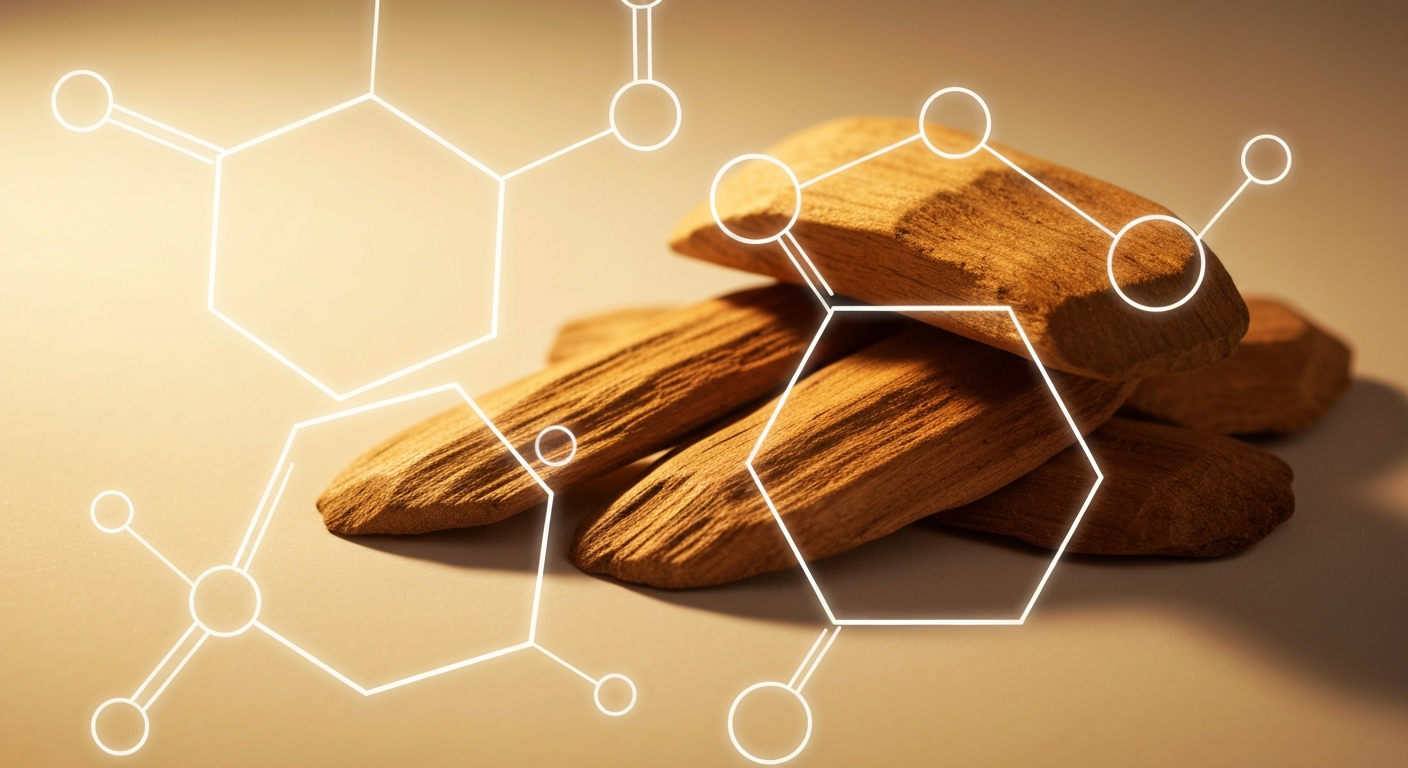
What it is, structurally
Androstenol is the common name for 5α-androst-16-en-3α-ol. It is a 16-androstene steroid with a hydroxyl group at the 3-position. It comes in two isomers, alpha and beta. They differ only in how that hydroxyl is oriented. Both show up in male axillary sweat, saliva, and urine, with measurable input from apocrine sweat glands.
It is biosynthetically related to androstenone . In the body, androstenol can oxidize into androstenone. That is part of why fresh sweat smells different from old sweat. The molecule was first isolated from boar testes in the 1940s, where it acts as part of the pig mating pheromone. Brooksbank and colleagues detected it in humans in the late 1960s.
Smell
This is where androstenol earns its keep in fragrance. Trained noses call it musky, woody, slightly sandalwood-like. There is a faintly urinous edge at high concentration. It is far more pleasant than androstenone, which most people read as sweaty or stale. It also skips the can't-quite-place-it sharpness of androstadienone.
At low doses it reads as a clean skin musk. It blends smoothly with citrus and woods. At high doses the animal edge comes through. But the polarizing 'is this body odor?' reaction that androstenone triggers is mostly absent. Sensitivity also varies less from person to person. That makes androstenol the easiest of the three to wear without fighting your blend.
The friendliness research
Androstenol's 'social' reputation traces to a small cluster of studies from the late 1970s and early 1980s. The most-cited is Kirk-Smith, Booth, Carroll and Davies (1978). It ran in Research Communications in Psychology, Psychiatry and Behavior. Participants wore surgical masks scented with androstenol. They rated photographs of people, especially women, as warmer and more attractive than unscented controls. The effect was real but modest, and the sample was small. That it keeps getting cited in pheromone copy is because, for its size, it found something.
A few years later came Filsinger, Braun, Monte and Linder (1984), in the Journal of Comparative Psychology. They looked at the related compound 5α-androst-16-en-3-one, or androstenone. Their seat-choice and self-rating data did not replicate cleanly. The paper is honestly closer to a null than a confirmation. I flag it because pheromone copy often lumps it in with Kirk-Smith as if both are positive findings, and they are not. That is the kind of sloppiness that made me distrust the marketing before I trusted the molecule.
A handful of smaller 1980s studies looked at waiting rooms. Women shown an androstenol-treated chair chose it more often than men did. That hinted at a sex-specific draw. The effect sizes were small, and the methods would not pass a modern preregistered review. But small and old is not the same as wrong — it is what an under-funded field looks like.
Tristram Wyatt's 2015 review in Proceedings of the Royal Society B is the field's most honest stocktake. It places androstenol in the 'interesting but not established' bucket. Read that the right way. It means nobody has run the large, funded, double-blind trial that would settle it — not that the trial was run and came back empty. There is real signal here. There just isn't the money behind human chemosignal work to chase it down.
Why it shows up in pheromone products
Formulators reach for androstenol for three practical reasons.
- It is meaningfully cheaper to source than androstadienone. That keeps the per-bottle cost in the $20-40 range where most of the category lives.
- It is less polarizing than androstenone. A blend built on it avoids the 'smells like a locker room' reactions that plague androstenone-heavy formulas.
- It rounds out the blend olfactively. The pheromone fraction needs to smell like something on its own, and androstenol's musk-sandalwood character does most of that work.
You will see it named on labels for Pure Instinct and the RawChemistry line. Both also include other 16-androstenes and a real perfumer's top-and-mid layer. When a product brags about its 'pheromone blend' without disclosing the ratio, androstenol is usually doing most of the heavy lifting.
How much matters
Doses in the original androstenol studies were in the low micrograms. Kirk-Smith used roughly 250µg dabbed onto a mask. Commercial pheromone perfumes don't publish their concentrations. But you can reverse-engineer it from total fragrance content and typical 16-androstene fractions. That puts most products in the 1-10mg-per-bottle range, applied two or three sprays at a time.
So the dose lands in the right neighborhood as the research. The catch is variation. Much less reliably reaches another person's nose. Wear it on warm skin under a collar. Don't wear it on cold clothing, where it will evaporate untouched.
Keep in mind that androstenol is volatile. Within four to six hours on skin it has largely evaporated or oxidized. Some of it turns into androstenone, which is when the wear can start to smell a little staler. That is the main reason pheromone perfumes are short-wear compared to a designer EDP.
If you're going to use it
A few honest expectations. Androstenol is the most wearable of the 16-androstenes. If you've tried a pheromone cologne and not hated the smell, you've probably worn one built on it. It is not the sledgehammer signal — androstadienone carries more of that load — but the 'friendly' read shows up in the field reports too, not just the copy. The smell genuinely reads as clean-musky, and it pairs well with citrus, vetiver, or sandalwood top notes.
It will not fix a life you haven't built, and no molecule walks a stranger across a room on command. What the right chemosignal does is quieter and more real: it changes how a room reads you before you open your mouth. Any product promising instant magnetism is selling you the wrapper, not the molecule. Use it the way you'd use any musk-leaning skin scent. Apply it lightly, on warm skin, layered under something you actually like the smell of.
Shopping by ingredient? Our best pheromone perfumes for men roundup tags which picks lean on androstenol versus the harsher 16-androstenes. Still on the fence about the whole category? Do pheromone perfumes work walks through what the evidence actually supports.
FAQ
What does androstenol smell like?
Musky and slightly sweet. Some people describe sandalwood. Others call it stale. It is more widely detectable than androstenone , so fewer people are blind to it.
Is androstenol the friendliness pheromone?
That is a marketing label, not a research finding. Kirk-Smith's 1978 study reported that people rated photographs more warmly when androstenol was present. The study was small and has not been reliably replicated. Treat the claim as unproven.
What is the difference between alpha and beta androstenol?
They are two forms of the same molecule. Alpha-androstenol is the one usually meant in fragrance contexts and carries the musky note. Beta-androstenol reads closer to sandalwood. Products rarely specify which they used.
How much androstenol should you use?
Less than you would expect. Androstenol turns sour as it oxidises. A light application that fades cleanly beats a heavy one that goes stale on skin. The synthetic musks in most blends are there partly to cover that sour edge.
Further reading
- Kirk-Smith, M., Booth, D. A., Carroll, D., & Davies, P. (1978). Human social attitudes affected by androstenol. Research Communications in Psychology, Psychiatry and Behavior 3: 379-384.
- Filsinger, E. E., Braun, J. J., Monte, W. C., & Linder, D. E. (1984). Human responses to the pig sex pheromone 5α-androst-16-en-3-one. Journal of Comparative Psychology 98(2): 219-222. DOI: 10.1037/0735-7036.98.2.219
- Wyatt, T. D. (2015). The search for human pheromones : the lost decades and the necessity of returning to first principles. Proceedings of the Royal Society B 282: 20142994. DOI: 10.1098/rspb.2014.2994
Keep reading
The VNO Debate: Do Humans Actually Have Pheromone Receptors?
The vomeronasal organ is the dedicated pheromone detector in many mammals. Humans have a pit that looks like one. The genes and the wiring tell a more complicated story.
Confidence and Chemistry Stack: The Placebo Question, Answered Honestly
Pheromone perfumes work, just not the simple way the marketing implies. The molecular signal is real. The scent is real. The expectation effect is real too. They stack, and that stack is worth paying for.
Pheromone Perfume Ingredients Explained (Plain English, No BS)
What is actually inside a pheromone perfume bottle, layer by layer. The molecules, the fragrance base doing most of the work, and the carrier. No jargon, no marketing fog.